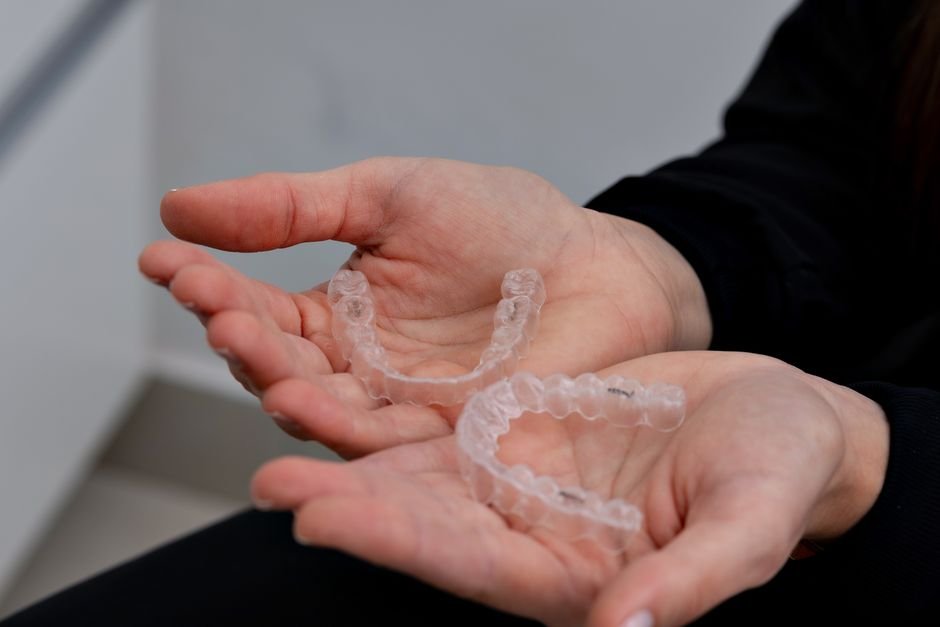
Clear aligners move teeth by applying gentle, controlled pressure through a series of custom-made plastic trays, each shaped slightly differently from the last. That steady pressure stimulates the bone around each tooth to break down on one side and rebuild on the other, so teeth shift a fraction of a millimetre at a time. Swapping to a new tray every week or two continues the movement until the planned final position is reached.
Key takeaways
- Aligners work through the same biological process as braces: bone remodelling around the tooth roots.
- Each tray moves teeth only a tiny amount, which is why treatment is planned in many small stages.
- Small tooth-coloured attachments help aligners grip teeth for more complex movements.
- Wearing aligners for around twenty to twenty-two hours a day is essential for results.
- Retainers are needed after treatment to stop teeth drifting back.
What Are Clear Aligners?
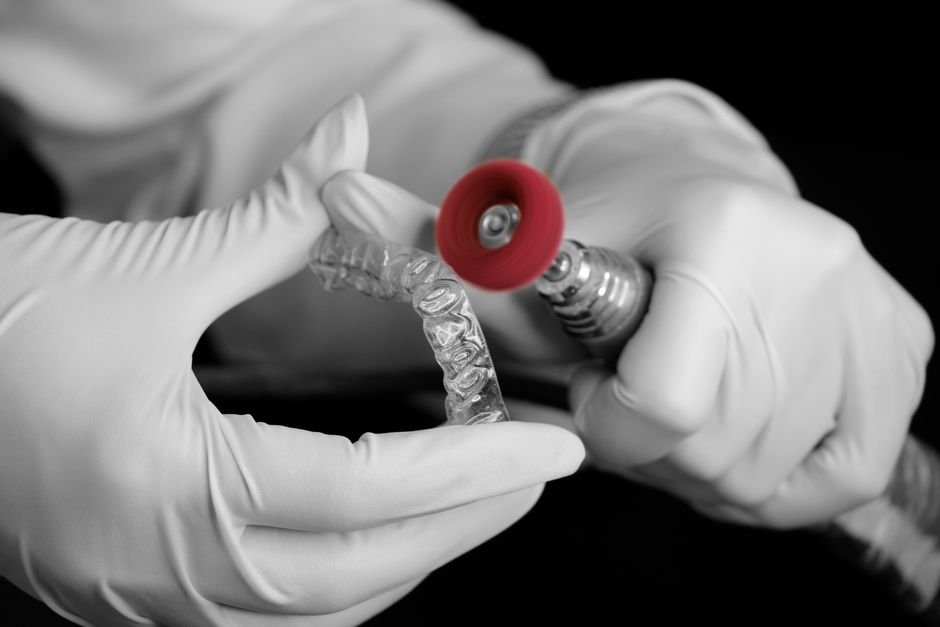
Clear aligners are thin, transparent plastic trays that fit snugly over the teeth. Each set is custom-made from a digital model of your mouth and is designed to move specific teeth by a very small amount. Rather than relying on brackets and wires, aligners use a sequence of trays worn one after another. Because they are almost invisible and removable, they have become a popular choice for adults and teenagers who want to straighten their teeth discreetly.
Aligners can treat a wide range of problems, including crowding, gaps, mild to moderate bite issues and teeth that have relapsed after earlier orthodontic treatment. More complex cases may still be better suited to fixed braces, and a dentist or orthodontist will advise which option is most appropriate. Regardless of the appliance, the underlying principle is the same: steady, gentle force applied over time allows the body to reshape the bone and reposition the teeth safely.
Step One: How Is Treatment Planned?
Treatment begins with a thorough assessment. Your dentist or orthodontist examines your teeth, gums and bite, checks for decay or gum disease that should be treated first, and usually takes X-rays to see the roots and bone. Photographs and a digital scan of your teeth are then taken. Modern intraoral scanners capture a detailed three-dimensional model in minutes without the need for messy impression material.
Using specialised software, the clinician maps out the movement of every tooth from its current position to the desired result. This plan is broken down into many small stages, each corresponding to one set of aligners. Many systems allow you to see a simulation of how your teeth are expected to move, which helps you understand the likely outcome. The clinician reviews and adjusts the plan carefully, because the quality of planning has a major influence on the final result.
Step Two: Why Are Attachments and Tooth Shaping Sometimes Needed?
Smooth plastic on a smooth tooth does not always provide enough grip for certain movements, such as rotating a rounded tooth or moving it vertically. To solve this, the dentist may bond small, tooth-coloured bumps called attachments onto some teeth. These are made from composite resin, the same material used for white fillings. The aligners are shaped to fit around them, giving the tray something to push against so it can guide the tooth precisely.
In some cases, a small amount of enamel is gently polished from between certain teeth to create space. This is known as interproximal reduction and removes only a fraction of a millimetre, staying well within the safe thickness of the enamel. It can help relieve crowding without extractions and improve how neighbouring teeth fit together. Both attachments and any reshaping are planned in advance, and attachments are polished away once treatment is complete.
Step Three: What Happens Biologically When an Aligner Applies Pressure?
Each tooth sits in a socket of bone, held by a thin cushion of fibres called the periodontal ligament. When an aligner presses on a tooth, the ligament is compressed on one side and stretched on the other. This change triggers specialised cells to respond. On the pressure side, cells called osteoclasts gradually break down bone, making room for the tooth to move. On the tension side, cells called osteoblasts lay down new bone to fill the space left behind.
This process, known as bone remodelling, is what makes orthodontic movement possible and safe. It happens slowly, which is why aligners are designed to move teeth by only a small amount at a time. Pushing too hard or too fast would not speed things up meaningfully and could damage the roots or supporting tissues. The gentle, consistent force of well-planned aligners allows the bone to keep pace, so teeth move steadily while the surrounding structures stay healthy.
Step Four: Why Do You Change Aligners Every Week or Two?
Each aligner is designed to move teeth a set distance. When you first put in a new tray it feels tight, because it is shaped for where your teeth are going rather than where they are. Over the following days, the teeth gradually move into the tray and the pressure eases. By the time a tray feels comfortable, it has largely done its job, and it is time to switch to the next one in the sequence.
Depending on the system and your clinician’s instructions, aligners are usually changed every one to two weeks. Some people notice mild soreness for a day or two after each change, which is a normal sign that the teeth are responding. It is important to follow the prescribed schedule rather than skipping ahead, as moving to the next tray before the teeth have caught up can cause the aligners to fit poorly and the treatment to go off track.
Step Five: Why Does Wear Time Matter So Much?
Aligners can only move teeth while they are in the mouth. Most clinicians recommend wearing them for around twenty to twenty-two hours a day, removing them only to eat, drink anything other than plain water, and clean your teeth. If aligners are left out for long periods, the pressure on the teeth stops and the bone remodelling process slows down. Teeth may even begin to drift back slightly.
Inconsistent wear is one of the most common reasons aligner treatment takes longer than expected or does not achieve the planned result. A tray that no longer fits snugly is often a sign that wear time has slipped. Practical habits help, such as always carrying a case, brushing promptly after meals and setting reminders to put trays back in. Treating aligners as something you wear all day, rather than something you put in when convenient, makes the biggest difference to success.
Step Six: What Happens at Check-Ups and Refinements?
Throughout treatment, you will have regular reviews, either in person or sometimes supported by remote monitoring. Your clinician checks that teeth are tracking as planned, that the aligners fit well and that the attachments are intact. They also keep an eye on gum health and any signs of decay, since good oral hygiene remains essential during treatment. Small issues can then be addressed before they become significant.
Teeth do not always move exactly as predicted, because everyone’s biology is slightly different. Towards the end of the main series, it is common for a new scan to be taken and an additional set of refinement aligners to be made. These fine-tune the position of any teeth that have not fully reached their target. Refinements are a normal part of aligner treatment rather than a sign that something has gone wrong.
Step Seven: Why Are Retainers Essential After Treatment?
When the final aligner has been worn, the teeth are in their new positions, but the bone and fibres around them need time to stabilise. The periodontal fibres in particular have a tendency to pull teeth back towards where they started. Teeth also continue to move naturally throughout life. Without retention, some or all of the improvement can be lost over time.
Retainers hold the teeth in place while everything settles and protect the result long-term. They may be removable clear retainers similar to aligners, or fixed wires bonded discreetly behind the front teeth. Your clinician will advise how often to wear them, which is often full-time at first and then at night. Many clinicians recommend continuing night-time wear indefinitely, because retainers are the most reliable way to keep a straightened smile.
Frequently Asked Questions
Do clear aligners hurt?
Clear aligners usually cause only mild discomfort. Many people feel pressure or slight soreness for a day or two after switching to a new aligner, as the teeth begin to move. This generally settles quickly and can be eased with soft foods and over-the-counter pain relief if needed.
How long does clear aligner treatment take?
Treatment time depends on how much the teeth need to move and how consistently the aligners are worn. Minor cases may take a few months, while more complex cases can take a year or longer. Your clinician will give you an estimate based on your individual treatment plan.
Can I eat with clear aligners in?
No. Aligners should be removed for eating and for drinking anything other than plain water. Food can damage the trays and drinks can become trapped against the teeth, increasing the risk of decay and staining. Brush or rinse before putting aligners back in.
What are aligner attachments?
Attachments are small tooth-coloured bumps of composite resin bonded to certain teeth. They give clear aligners extra grip so the trays can perform more precise movements, such as rotations. Attachments are removed and the teeth polished smooth once aligner treatment has finished.
Will my teeth move back after clear aligner treatment?
Teeth can drift back towards their original positions if retainers are not worn after clear aligner treatment. Wearing retainers as instructed, often full-time at first and then at night long-term, is the most reliable way to keep teeth straight once treatment is complete.

Matthew is a dental content writer passionate about helping readers understand their oral health, one article at a time.