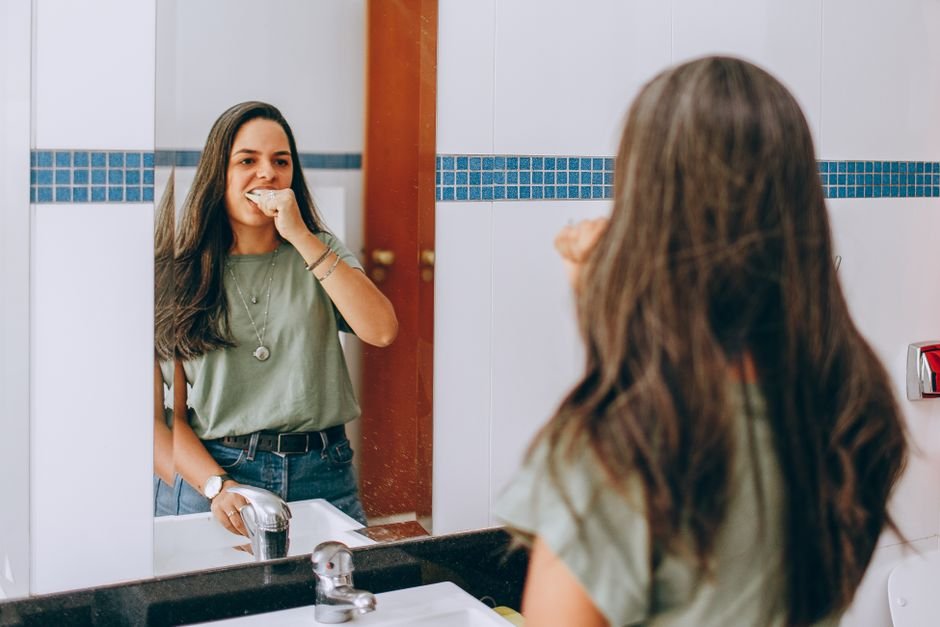

The simplest way to build consistency into a busy oral care routine is to attach brushing and flossing to habits you already perform automatically, keep the required tools within arm’s reach, and lower the effort needed so there is no decision to make in the moment. Consistency beats intensity: brushing twice a day for two minutes every single day protects teeth and gums far more effectively than an occasional thorough session followed by several rushed or skipped ones. The goal is not to find more time, but to remove the friction that causes oral care to be the first thing dropped when a day gets hectic.
Key takeaways
- Consistency matters more than perfection — a rushed but daily routine outperforms an occasional deep clean.
- Linking brushing and flossing to existing habits, such as making coffee or setting an alarm, removes the need for willpower.
- Keeping a travel-sized kit and simplified tools ready reduces the excuses that break a routine.
- Families with mismatched schedules do better with individual, staggered routines than one shared rule.
- Missing a day occasionally is normal; what protects long-term oral health is returning to the routine immediately rather than abandoning it.
Why Does Consistency Matter More Than Perfection?
Plaque begins reforming on tooth surfaces within hours of a clean, which is why oral health depends on repeated, predictable action rather than occasional intensity. A person who brushes adequately every day, even if the technique is not flawless, generally has better gum health than someone who brushes thoroughly a few times a week but skips days under pressure. This is because bacterial colonies need consistent disruption to stay below the level that triggers inflammation and decay. Sporadic effort allows plaque to mature and harden into tartar, which a toothbrush alone cannot remove.
Understanding this shifts the goal away from “doing it properly” toward “doing it reliably.” A two-minute brush with reasonable coverage, done every morning and night without fail, protects enamel and gum tissue more effectively than an inconsistent routine padded out with occasional extra-long sessions. This reframing matters for busy people because it removes the pressure to be perfect and replaces it with a lower, more achievable bar: show up daily, keep it simple, and let repetition do the protective work that intensity cannot replicate on its own.
How Can Habit-Stacking Make Oral Care Automatic?
Habit-stacking means attaching a new behaviour to one that is already automatic, so the existing habit acts as the trigger for the new one. Brushing after the kettle boils, flossing while a phone charges overnight, or rinsing with mouthwash immediately after removing makeup all use an established routine as a built-in reminder. Because the cue is already wired into the day, there is no need to remember or decide anything — the existing action simply carries the new one along with it. This is far more reliable than depending on motivation, which naturally dips on stressful or exhausting days.
The technique works best when the anchor habit happens at a consistent time and place, such as a bathroom-based routine like washing the face or applying moisturiser. Placing oral care tools physically next to that anchor habit reinforces the link visually as well as behaviourally. Over several weeks, the paired actions start to feel like a single routine rather than two separate tasks, which is exactly the outcome busy people need: less conscious effort, less chance of the habit being dropped when a schedule tightens.
What Is the Quickest Way to Fit Flossing Into a Hectic Schedule?
Flossing is the step most often skipped under time pressure, largely because traditional string floss requires two free hands, a mirror, and a few minutes of careful manoeuvring. Interdental brushes or floss picks solve this by being faster to use one-handed, which makes them realistic for a rushed morning or a quick clean after lunch at a desk. The specific tool matters less than whether it actually gets used daily; the best interdental tool is the one that fits naturally into an already tight routine without adding noticeable time.
Keeping floss picks in multiple locations — a bag, a car, a desk drawer, beside the bed — removes the “I don’t have it with me” excuse that derails consistency. Some people find it easier to floss before brushing at night rather than treating it as a separate final step, since it becomes bundled into the same short window rather than requiring a second trip back to the basin. The exact timing matters far less than making the action low-effort enough to survive a genuinely busy day.
How Do You Keep Up Oral Care While Travelling or Working Irregular Hours?
Irregular schedules, whether from shift work, travel, or unpredictable workdays, break routines built around fixed clock times. A more resilient approach is to anchor oral care to events rather than hours: brush after waking and before sleeping, regardless of what time those events actually occur. This keeps the twice-daily pattern intact even when a person’s day looks completely different from one week to the next, which is far more sustainable than a routine that only works on a standard nine-to-five schedule.
A dedicated travel kit that stays permanently packed, rather than being assembled before each trip, removes another common point of failure. A small toothbrush, travel-sized toothpaste, and a few floss picks kept in a wash bag or overnight bag mean the routine does not depend on remembering to pack anything at the last minute. For frequent travellers, duplicating this kit so one version always stays in transit removes an entire category of decisions and forgotten items from an already busy schedule.
What Tools Can Simplify a Rushed Routine Without Cutting Corners?
Certain tools reduce the time and attention a thorough clean requires without lowering its effectiveness. An electric toothbrush with a built-in timer removes the guesswork around brushing duration and often covers tooth surfaces more efficiently than manual brushing, since the device does much of the mechanical work itself. Pre-threaded flossers and water flossers similarly cut down the dexterity and time a full clean demands, making them useful options for anyone whose day rarely allows for a leisurely bathroom routine.
Simplifying tools is not about lowering standards; it is about matching the routine to real life so it actually happens. A single well-chosen electric toothbrush and a stock of interdental brushes usually outperform an elaborate multi-product routine that gets abandoned within a fortnight because it is too time-consuming to sustain. The most effective oral care setup is rarely the most comprehensive one on paper — it is the one simple enough to survive contact with a genuinely busy week.
How Should Families With Different Schedules Coordinate Oral Care?
Households with mismatched routines — different school run times, shift patterns, or bedtimes — often struggle when they try to enforce one shared oral care schedule for everyone. It usually works better to treat each family member’s routine individually, anchored to their own fixed points in the day, rather than expecting the whole household to brush at the same moment. A visual reminder, such as a chart near the bathroom mirror, can help younger children build the habit independently of adult schedules that shift from day to day.
For families juggling several children’s routines alongside their own, keeping each person’s toothbrush, toothpaste, and floss visibly separated and easily accessible reduces the friction of a crowded bathroom at busy times of day. Short, predictable routines are easier for children to stick to than long ones, so two focused minutes morning and night will generally succeed where a longer but inconsistently supervised routine fails. Coordinating expectations rather than exact timing keeps the habit realistic for every member of a busy household.
What Happens When You Miss a Day, and How Do You Get Back on Track?
Missing an occasional brushing or flossing session does not undo an otherwise consistent routine, and treating a single lapse as a failure often does more harm than the lapse itself. All-or-nothing thinking is one of the most common reasons busy people abandon oral care habits altogether — a missed night gets framed as proof the routine “isn’t working,” rather than as a normal, low-impact blip in an otherwise solid pattern. The oral cavity is resilient enough to absorb the occasional missed session without lasting damage, provided the routine resumes promptly.
The most useful response to a missed session is simply to resume the routine at the very next opportunity, without adding extra steps to compensate or dwelling on the gap. Trying to “make up for it” with an unusually long or aggressive session can be counterproductive, particularly with brushing pressure on gum tissue. A steady, forgiving mindset — get back to the normal routine as soon as possible — protects consistency far better than perfectionism, which tends to collapse entirely the first time a routine is interrupted.
How Can You Track Progress Without It Becoming a Chore?
Lightweight tracking can reinforce consistency, but only if it takes seconds rather than becoming another task competing for attention in an already busy day. A simple tick on a wall calendar, a habit-tracking app already installed on a phone, or the built-in usage timer on an electric toothbrush can all provide quiet feedback on whether the routine is actually happening as intended, rather than relying on memory or assumption. Visible tracking is particularly effective for children, who often respond well to seeing a streak build up over consecutive days.
The purpose of tracking is to notice patterns, not to create pressure. If a particular day of the week consistently shows a missed session, that is useful information — perhaps that evening involves a later finish or a different routine entirely — and the anchor habit can be adjusted accordingly. Tracking should stay optional and low-stakes; the moment it starts to feel like an obligation, it risks becoming another task that gets abandoned, defeating the purpose it was meant to serve.
Frequently Asked Questions
Is it better to brush thoroughly a few times a week or briefly every day?
Briefly but consistently every day is better. Plaque reforms continually, so daily disruption — even if the technique is not perfect — controls bacterial buildup far more effectively than infrequent, longer sessions with gaps in between.
How long should a realistic daily oral care routine take?
A complete routine of brushing and interdental cleaning can reasonably take around three to four minutes twice a day. This is short enough to fit into most schedules while still covering all tooth surfaces and the spaces between teeth.
Does an electric toothbrush make consistency easier than a manual one?
For many people, yes. Built-in timers and pressure sensors remove guesswork, and the brush does more of the mechanical work, which can make the routine feel quicker and less effortful, encouraging it to happen reliably each day.
What is the simplest way to remember flossing every day?
Pair flossing with an existing habit that already happens daily, such as right after brushing at night, and keep floss picks visible and within reach rather than stored away, so no extra step or memory is required to start.
Can a broken oral care routine be rebuilt after weeks of inconsistency?
Yes. Oral tissues respond quickly to renewed care, and a routine can be re-established by restarting with a simple, low-effort version rather than an ambitious one, then anchoring it to a daily habit so it becomes automatic again.

Matthew is a dental content writer passionate about helping readers understand their oral health, one article at a time.